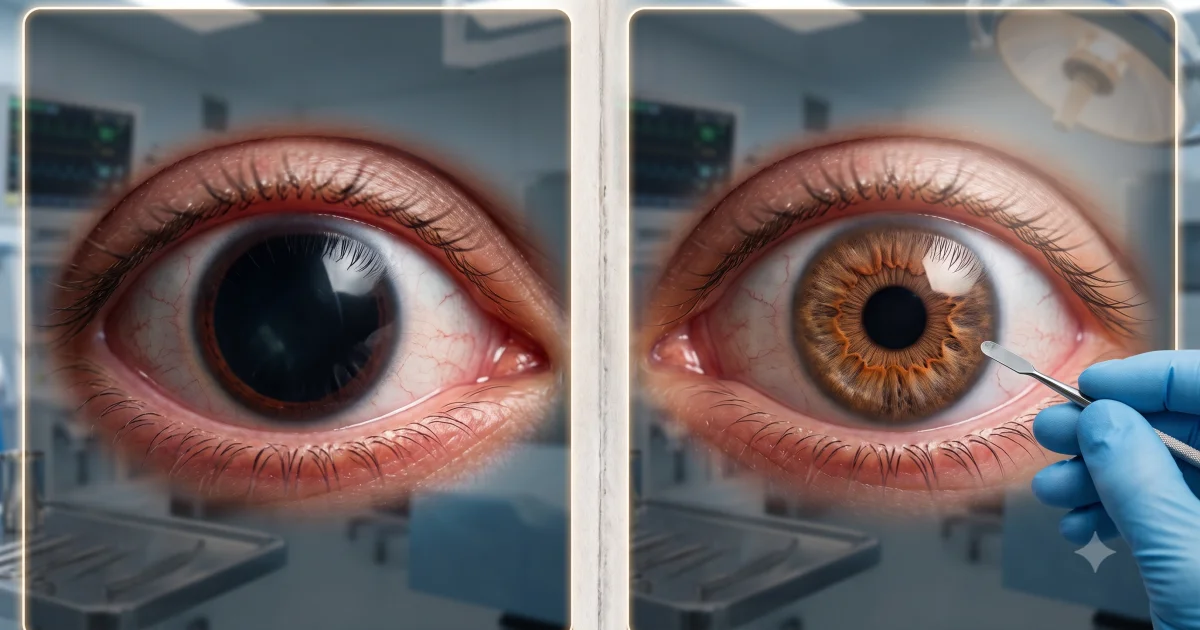
FLAAK Keratopigmentation for Aniridia and Ocular Albinism

Congenital aniridia and ocular albinism are two rare but profoundly disabling conditions, with one of the most distressing symptoms being severe photophobia. When the iris is absent, malformed, or completely depigmented, the eye can no longer regulate the amount of light that reaches the retina. FLAAK keratopigmentation represents an innovative and functional medical solution today, enabling these patients to regain significant visual comfort and a transformed quality of life. Yoni Gozlan, M.D., an Ophthalmic Surgeon and pioneer of this technique in Paris, supports these patients with expertise and care.
Aniridia and Ocular Albinism: Two Conditions That Share a Common Burden
Congenital aniridia is a genetic malformation characterized by the total or partial absence of the iris. Without this natural diaphragm, the pupil remains permanently wide open, unable to adapt to ambient brightness. The result is severe photophobia that makes daily activities — driving, reading, working on screens, going outdoors — extremely painful or even impossible. Patients suffer from constant glare, recurrent migraines, and profound visual fatigue.
Ocular albinism, whether isolated or associated with cutaneous albinism (oculocutaneous albinism), manifests as an absence or major insufficiency of melanin in the structures of the eye, particularly in the iris and the retina. The absent or depigmented iris cannot fulfill its role as a light filter. Light enters in a diffuse and uncontrolled manner, causing the same disabling glare phenomena. These patients also often experience nystagmus and reduced visual acuity, but it is photophobia that most significantly impacts their daily lives.
Faced with these two conditions, traditional solutions — tinted glasses, colored contact lenses, artificial diaphragm lenses — present significant limitations: prolonged discomfort, infection risk associated with lens wear, insufficient aesthetics, and above all, partial effectiveness. It is within this context that FLAAK keratopigmentation establishes itself as a serious and lasting alternative, grounded in a genuine functional medical indication.
FLAAK Keratopigmentation: A Surgical Technique Serving Visual Comfort
FLAAK keratopigmentation — standing for Femtosecond Laser Assisted Arcuate Keratopigmentation — is a surgical procedure that involves depositing biocompatible pigments within the corneal stroma, in precise tunnels created using a femtosecond laser. This cutting-edge technology allows micrometric precision, ensuring a result that is homogeneous, durable, and safe.
In the context of congenital aniridia and ocular albinism, FLAAK keratopigmentation simulates the presence of a functional iris by creating a pigmented zone on the cornea that mechanically limits light penetration. This artificial filtration mechanism reproduces, at least in part, the natural function of the absent or deficient iris. The improvement in visual comfort experienced by patients is often remarkable and rapid.
A Precise, Personalized, and Reproducible Procedure
Yoni Gozlan, M.D., who performs FLAAK keratopigmentation at Clinique Laser Victor Hugo in Paris 16, adapts each intervention to the specific anatomical characteristics and functional needs of the patient. The size of the pigmented zone, the choice of color, and the depth of the stromal tunnels are all personalized. In a patient with aniridia, the transparent zone left at the center of the cornea (simulating the pupil) can be adjusted to optimize both vision and protection against light. In a patient suffering from ocular albinism, the pigment density is calculated to match the degree of iris depigmentation.
FLAAK keratopigmentation is performed on an outpatient basis, under local anesthesia, and generally takes less than one hour per eye. Postoperative recovery is straightforward, with a few days of local antibiotic and anti-inflammatory treatment. The patient can observe a very early improvement in photophobia, often within the first days following the procedure.
Proven Clinical Results for Rare Conditions
The clinical results of FLAAK keratopigmentation in the treatment of photophobia related to aniridia and ocular albinism are encouraging. Many patients report a significant reduction in glare, improved tolerance to both natural and artificial light, and a substantial improvement in their quality of life. Objectively, studies have demonstrated a measurable decrease in light sensitivity after the procedure, with long-term stability of results.
Dr. Gozlan follows each patient over the long term, with regular postoperative consultations to evaluate progress and adjust management if necessary. This comprehensive medical approach, far from being a simple aesthetic endeavor, positions FLAAK keratopigmentation as a genuine therapeutic tool recognized within the international ophthalmological community.
Functional Medical Indication: When FLAAK Keratopigmentation Changes Lives
It is essential to emphasize that in the context of congenital aniridia and ocular albinism, FLAAK keratopigmentation is not an aesthetic comfort procedure. It is a full-fledged functional medical indication, aimed at correcting a major physiological deficit: the eye's inability to regulate light flow. This distinction is fundamental, as it determines the clinical approach, the preoperative assessment, and the expected objectives of the intervention.
Before any surgical decision, a comprehensive ophthalmological assessment is performed, including corneal topography, an evaluation of the corneal endothelium, a fundus examination, and a functional assessment of photophobia. This evaluation ensures that the cornea is suitable to receive the treatment and that the expected benefits are consistent with the patient's clinical situation.
FLAAK keratopigmentation can also be considered for patients who have already undergone other treatments (specialized contact lenses, previous surgery) without obtaining sufficient relief. In these complex cases, the expertise of Yoni Gozlan, M.D. and his specific experience with FLAAK keratopigmentation in atypical profiles are decisive advantages for providing an adapted and safe management plan.
Rare conditions such as aniridia and ocular albinism often require a long and challenging care journey. FLAAK keratopigmentation is not a miracle solution, but it represents a real, measurable, and lasting advancement for patients who, until now, had few effective surgical options at their disposal. Restoring these patients' ability to go out into daylight without suffering, to work normally, and to enjoy simple activities that so many others take for granted: this is the clinical and human ambition that drives this approach.
- Congenital aniridia: total or partial absence of the iris, permanent severe photophobia
- Ocular albinism: absent or depigmented iris, absence of natural light filtration
- FLAAK keratopigmentation: simulation of a functional iris through stromal deposition of biocompatible pigments
- Functional medical indication: improvement of visual comfort and quality of life
- Clinical results: reduction of photophobia, long-term stability, personalized follow-up
If you or a loved one are affected by congenital aniridia, ocular albinism, or any other condition causing severe photophobia related to an absent or depigmented iris, do not wait to explore the possibilities offered by FLAAK keratopigmentation. Schedule an appointment today with Yoni Gozlan, M.D. for a personalized evaluation consultation and discover whether this innovative corneal pigmentation surgery solution is suited to your situation. A new quality of visual life awaits you.
Back to articles | Learn more about FLAAK keratopigmentation
FLAAK keratopigmentation represents a major advancement for patients with aniridia or ocular albinism. Thanks to the expertise of Yoni Gozlan, M.D., FLAAK keratopigmentation significantly improves visual comfort and quality of life for these patients.