Corneal Tattoo vs FLAAK Keratopigmentation: The Differences

The confusion between corneal tattoo and FLAAK keratopigmentation is common among patients who wish to change their eye color. Yet these two techniques have almost nothing in common — not in their principle, not in their safety, and not in their results. Yoni Gozlan, M.D., Ophthalmic Surgeon specializing in FLAAK keratopigmentation at Centre Laser Victor Hugo (Paris 16), regularly sees patients who are worried after discovering videos of ocular tattoos with sometimes dramatic consequences on social media. The purpose of this article is to definitively clarify the difference between corneal tattoo and FLAAK keratopigmentation, so that everyone can make an informed and safe choice.
Corneal Tattoo and FLAAK Keratopigmentation: Two Very Different Realities
The term "corneal tattoo" is sometimes used generically to refer to any technique aimed at coloring the cornea. It is precisely this generalization that creates confusion. In reality, traditional corneal tattoo and FLAAK keratopigmentation differ in their technology, their pigments, their medical oversight, and their level of safety. To understand the foundations of the FLAAK method, it is helpful to consult the dedicated page on FLAAK keratopigmentation surgery, which details the complete surgical protocol as practiced by Yoni Gozlan, M.D..
Corneal tattoo has existed since the 19th century. It was initially developed to mask corneal leucomas — unsightly white scars on the cornea — in patients who had lost vision in one eye. It was therefore not truly an aesthetic procedure, but rather a palliative and rudimentary solution. In contrast, FLAAK keratopigmentation is a 21st-century surgical technique, designed from the outset to offer a safe, reproducible, and long-lasting eye color change, for both aesthetic and therapeutic purposes.
Traditional Corneal Tattoo: A Risky and Obsolete Technique
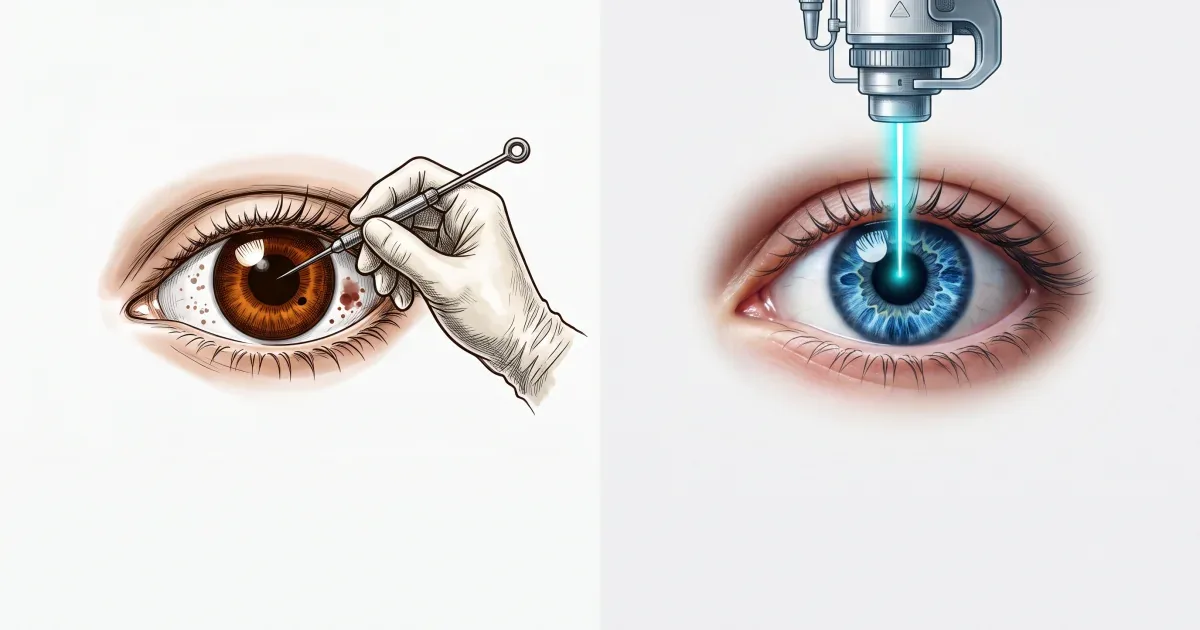
- Principle of the technique: Traditional corneal tattoo involves perforating the surface of the cornea using a fine needle to inject or deposit a colored pigment. This superficial perforation is performed manually, without precise control of depth. The technique has barely evolved since its origins in the 19th century, making it fundamentally artisanal and difficult to reproduce.
- Pigments used: The pigments used in conventional corneal tattooing are generally not certified for intracorneal use. In the most concerning cases, particularly when the procedure is performed in countries without strict regulations, skin tattoo inks are used. These substances have not been subject to any ocular biocompatibility studies and can cause severe inflammatory or even toxic reactions.
- Major infection risk: Perforation of the corneal epithelium creates a direct entry point for bacteria. Corneal tattoo is dangerous precisely because it exposes the patient to potentially severe infectious keratitis, which can lead to corneal ulceration, permanent opacification, and in extreme cases, loss of the eye. The risk is heightened when the procedure is performed outside a sterile medical environment.
- Pigment migration: In the absence of a closed tunnel to contain the pigment, the colored particles deposited on or within the cornea can migrate over time. This diffusion phenomenon leads to a heterogeneous result, with irregular color zones, spots, and an appearance that progressively deteriorates over months or years.
- Unpredictable results: The aesthetic outcome of traditional corneal tattoo is random. The color obtained depends on multiple uncontrolled factors: depth of injection, type of pigment, and individual corneal reaction. Touch-ups are difficult and risky, and there is no standardized protocol guaranteeing a uniform and natural result.
FLAAK Keratopigmentation: A Medically Supervised Precision Surgery
The FLAAK technique (Femto Laser-Assisted Annular Keratopigmentation) represents a complete technological breakthrough compared to corneal tattoo. Yoni Gozlan, M.D. points out that the two techniques share the same goal, but that the method, the level of control and the safety profile are very different.
- Creation of an intrastromal tunnel with femtosecond laser: Instead of perforating the cornea, the surgeon uses a femtosecond laser to create an annular tunnel inside the corneal stroma, at a precise and pre-programmed depth. This tunnel is closed: it does not breach either the epithelium (superficial layer) or the endothelium (deep layer). The structural integrity of the cornea is therefore preserved.
- Certified biocompatible pigments: The pigments used in FLAAK keratopigmentation are specifically developed and certified for intracorneal use. They have undergone rigorous biocompatibility testing. Their composition is designed for good tolerance by ocular tissues and chromatic stability over time. To learn more about available shades, consult the article on colors chosen in FLAAK keratopigmentation.
- No perforation of the corneal surface: The absence of perforation eliminates the risk of direct infectious keratitis related to the procedure. The intrastromal tunnel constitutes a confined and protected space. It is this characteristic that fundamentally distinguishes FLAAK keratopigmentation from the dangers of keratopigmentation often associated with non-medical techniques.
- Homogeneous and natural result: The pigment is deposited uniformly within the annular tunnel, which promotes a regular and aesthetic chromatic result. The annular shape of the tunnel reproduces the natural appearance of the iris, with a harmonious and realistic look. The results of FLAAK keratopigmentation are reproducible and predictable from one patient to another.
- Procedure performed in the operating room: FLAAK keratopigmentation is a full-fledged ophthalmic surgery. It is performed by a qualified surgeon in a sterile environment, with topical anesthesia and high-technology instrumentation. Dr. Gozlan personally oversees every step, from the preoperative consultation before FLAAK keratopigmentation through to the procedure.
Why Are These Two Techniques So Often Confused?
The confusion between corneal tattoo and FLAAK keratopigmentation can be explained by several factors that Yoni Gozlan, M.D. regularly identifies during his consultations:
- The misuse of the word "tattoo": On social media and in mainstream media, the term "eye tattoo" is used interchangeably to refer to traditional corneal tattoo, FLAAK keratopigmentation, and even scleral tattoo (the white part of the eye). This semantic shortcut perpetuates a harmful confusion, as it places on the same level procedures with radically different levels of risk.
- The virality of sensational videos: Videos of ocular tattoos performed under non-medical conditions, sometimes with catastrophic consequences, are widely shared on social platforms. These viral contents associate in the public's mind any eye color modification with a dangerous and irresponsible act, without distinguishing between techniques.
- The lack of regulation in certain countries: Corneal tattoo is dangerous primarily when it is performed outside any medical framework, by non-professionals, in countries where no regulation protects patients. These clandestine practices tarnish the image of medical keratopigmentation, which is in fact a rigorously supervised surgery. To separate fact from fiction, consult the article on misconceptions about FLAAK keratopigmentation.
- Public lack of knowledge: The cornea, its anatomical layers, and the differences between a superficial injection at the epithelial level and a controlled deposit within the stroma are not concepts familiar to most patients. Without a thorough medical explanation, it is difficult to understand what sets FLAAK keratopigmentation apart from traditional corneal tattooing in terms of safety.
What the FLAAK Technique Brings Compared to Ancestral Methods
FLAAK keratopigmentation does not simply represent an improvement over corneal tattoo: it is a complete departure from it. The contribution of FLAAK technology can be summarized in five major advances that position it as the only medically acceptable method for modifying eye color at the corneal level.
- Micrometric precision: The femtosecond laser allows the surgeon to program the depth, diameter, and geometry of the intrastromal tunnel with micrometer-level precision. This technological mastery was simply impossible with a manual needle. It supports the reproducibility and safety of each procedure.
- Pigment traceability: Each pigment used in FLAAK keratopigmentation has a certificate of conformity and a traceable batch number. Dr. Gozlan exclusively uses pigments whose stability of eye color after surgery has been documented over the long term. This traceability is nonexistent in traditional corneal tattoo.
- Preservation of vision: The annular tunnel is designed to surround the pupil without encroaching on the central visual axis. Thus, the patient's vision is not altered by the procedure. Corneal tattoo, on the other hand, can cause central opacities that impair vision if the pigment migrates or if the technique is poorly controlled.
- Reversibility: FLAAK keratopigmentation should be treated as permanent. Two pigment removals have been published (in 2025 and 2026): both required another corneal operation, and the pigment could not be removed completely. You should not count on going back.
- Comprehensive care pathway: FLAAK keratopigmentation is part of a structured care pathway that includes a complete preoperative assessment, surgery in the operating room and a codified postoperative treatment plan. To learn about the details of the recovery period, consult the article on recovery after FLAAK keratopigmentation.
FAQ: Corneal Tattoo and FLAAK Keratopigmentation
Do corneal tattoo and FLAAK keratopigmentation use the same technique?
No, the two techniques are fundamentally different. Traditional corneal tattoo relies on manual perforation of the corneal surface using a needle, while FLAAK keratopigmentation uses a femtosecond laser to create a closed intrastromal tunnel, without any perforation. Yoni Gozlan, M.D. emphasizes that these are two approaches that share only the final goal of coloring the cornea, but whose safety and sophistication are not comparable.
Is corneal tattoo dangerous?
Yes, corneal tattoo is dangerous, especially when it is performed outside a strict medical framework. The risks include severe corneal infections, toxic reactions to uncertified pigments, pigment migration, and irreversible damage that can lead to vision loss. Dr. Gozlan strongly advises against this technique and offers interested patients an assessment for FLAAK keratopigmentation, performed with a femtosecond laser in a controlled surgical setting.
Why do social media confuse corneal tattoo and keratopigmentation?
Social media often use the generic term "eye tattoo" to refer to any ocular coloring technique, without distinction. Viral videos rarely specify the method used, which fuels the confusion. Yoni Gozlan, M.D. observes that this conflation unfairly discourages patients who could benefit from FLAAK keratopigmentation, a rigorously supervised surgery that is very far removed from non-medical practices.
Are the pigments used in FLAAK keratopigmentation the same as those used in tattoos?
Absolutely not. The pigments used in FLAAK keratopigmentation are specifically designed and certified for intracorneal use. They have been tested for their biocompatibility with ocular tissues and their chromatic stability over time. The pigments of traditional corneal tattoo — and even more so the skin tattoo inks sometimes repurposed — offer none of these guarantees. Dr. Gozlan uses biocompatible pigments designed for medical use.
Can FLAAK keratopigmentation damage vision?
FLAAK keratopigmentation is designed to fully preserve visual acuity. The annular intrastromal tunnel is created around the pupil, without encroaching on the central optical axis. Clinical studies and the experience of Yoni Gozlan, M.D. confirm that vision is not altered by the procedure when it is performed under standard conditions. This is a major difference from corneal tattoo, which can cause visual opacities.
How can you be sure you are choosing the right technique to change your eye color?
The only way to make an informed choice is to consult a specialized Ophthalmic Surgeon. Dr. Gozlan performs a comprehensive assessment during the preoperative consultation to verify the patient's eligibility for FLAAK keratopigmentation and to explain the protocol in detail. This consultation allows any contraindications to be ruled out and all patient questions about the differences between available techniques to be answered.
When to Consult Yoni Gozlan, M.D.?
If you are considering an eye color change and have questions about the difference between corneal tattoo and FLAAK keratopigmentation, it is essential to consult a specialist before taking any steps. Yoni Gozlan, M.D. welcomes you for a personalized consultation to evaluate your situation, perform a complete ophthalmological assessment, and determine whether you are eligible for FLAAK keratopigmentation. This consultation is an opportunity to obtain clear and medically grounded answers, far from the approximations of social media, and to understand what sets the FLAAK technique, performed with a femtosecond laser by an ophthalmic surgeon, apart from non-medical practices.
📍 Consultation at Centre Laser Victor Hugo – Paris 16
Yoni Gozlan, M.D. welcomes you at Centre Laser Victor Hugo, 27 bis avenue Victor Hugo 75116 Paris to explain in detail the differences between corneal tattoo and FLAAK keratopigmentation and to assess your eligibility for this precision corneal pigmentation surgery.
Book an AppointmentFurther Reading
- FLAAK keratopigmentation surgery: discover the complete surgical protocol of the FLAAK technique step by step.
- Dangers of FLAAK keratopigmentation: learn about the real risks and the preventive measures in place.
- Contraindications to FLAAK keratopigmentation: check the eligibility criteria before considering the procedure.
- Misconceptions about FLAAK keratopigmentation: separate fact from fiction about this surgery.
- Results of FLAAK keratopigmentation: view the results achieved by Dr. Gozlan's patients.