Refractive Surgery and FLAAK Keratopigmentation

I have already undergone refractive surgery. Is keratopigmentation still possible? This question frequently arises among patients who have had LASIK, PRK, or SMILE and now wish to permanently change their eye color. Yoni Gozlan, M.D., Ophthalmic Surgeon specializing in FLAAK keratopigmentation in Paris 16, explains the compatibility between these two procedures, the specific precautions to take, the preoperative assessment process, and the expected results on a previously operated cornea.
What Is FLAAK Keratopigmentation After Refractive Surgery?
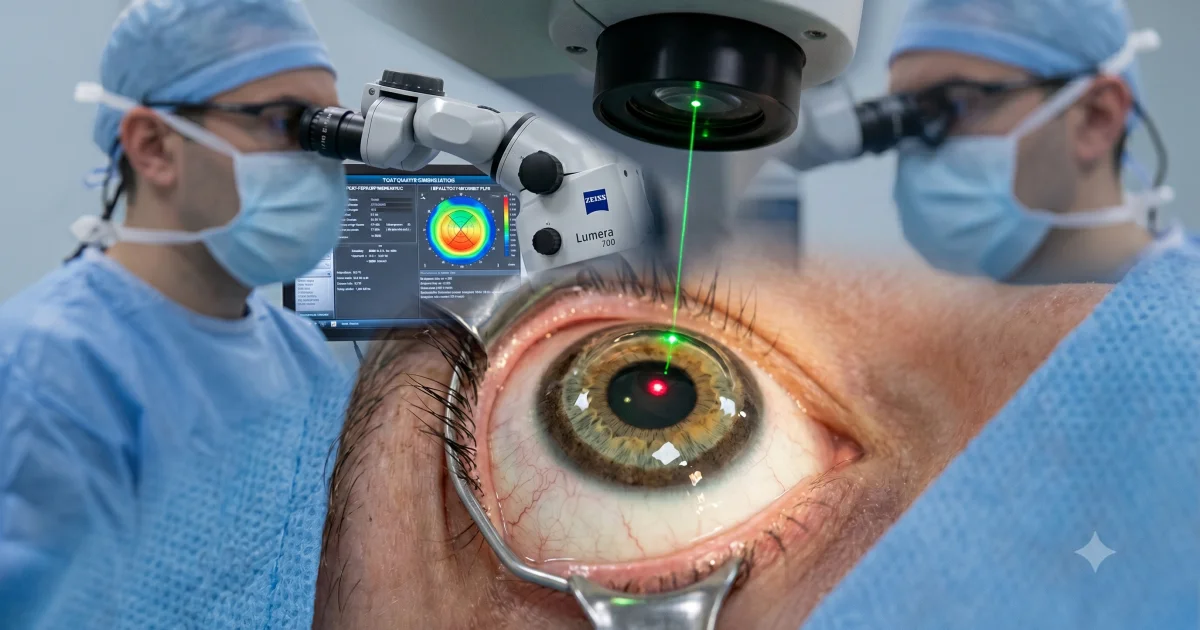
FLAAK keratopigmentation is a surgical technique that permanently changes eye color by depositing biocompatible pigments into the corneal stroma using a femtosecond laser. When a patient asks, "I have already undergone refractive surgery. Is keratopigmentation still possible?", the answer is generally reassuring: both procedures act on distinct corneal layers and zones.
Refractive surgery (LASIK, PRK, SMILE) modifies the curvature of the cornea to correct vision, while keratopigmentation creates an intrastromal tunnel designed to receive colored pigments. Yoni Gozlan, M.D., Former Clinical Fellow in Ophthalmology and member of the SFO and SAFIR, evaluates each case individually to determine the feasibility of the procedure in complete safety.
I Have Already Undergone Refractive Surgery. Is Keratopigmentation Still Possible? The Conditions to Meet
For patients who ask themselves "I have already undergone refractive surgery. Is keratopigmentation still possible?", several criteria must be verified:
- Sufficient residual corneal thickness: After LASIK or PRK, the cornea is thinner. Adequate residual stromal thickness is essential to safely create the femtosecond tunnel. Corneal topography and pachymetry allow precise measurement of this parameter.
- Confirmed refractive stability: The visual correction must have been stable for at least 12 months following refractive surgery. Any residual progression of myopia, hyperopia, or astigmatism must be ruled out before considering keratopigmentation.
- Absence of associated corneal pathology: Post-LASIK corneal ectasia, subclinical keratoconus, or any abnormal corneal scarring constitute contraindications to FLAAK keratopigmentation. A comprehensive assessment enables their detection.
- Adequate postoperative waiting period: A minimum interval of 12 to 18 months after refractive surgery is generally recommended to allow complete corneal healing.
Yoni Gozlan, M.D. performs a thorough preoperative assessment during the initial consultation to confirm each patient's eligibility.
I Have Already Undergone Refractive Surgery. Is Keratopigmentation Still Possible? The Specific Preoperative Assessment
When a patient who has already benefited from laser correction wonders whether keratopigmentation after refractive surgery is feasible, the preoperative assessment is particularly important:
Step 1: Corneal Topography and Tomography
Yoni Gozlan, M.D. performs a complete mapping of the cornea using state-of-the-art equipment. This step evaluates the regularity of the corneal surface, measures the residual stromal thickness, and identifies any anomalies related to the previous refractive surgery. The data collected is essential for programming the femtosecond laser with optimal precision.
Step 2: Detailed Biomicroscopic Examination
A slit-lamp examination allows visualization of the corneal flap created during LASIK or the photoablation zone from PRK. The surgeon checks for the absence of flap folds, residual corneal haze, or opacities that could interfere with the keratopigmentation procedure. The condition of the corneal endothelium is also assessed.
Step 3: Intraocular Pressure and Fundus Evaluation
Measurement of the intraocular pressure (IOP) corrected for corneal thickness is essential after refractive surgery. A fundus examination completes the assessment to ensure retinal health. These examinations confirm that the eye as a whole is suitable for FLAAK keratopigmentation.
Step 4: Shade Selection and Simulation
Among the 16 available shades, Dr. Gozlan helps the patient choose the color best suited to their natural iris and aesthetic expectations. It is important to note that a history of refractive surgery does not influence the choice of available colors in FLAAK keratopigmentation.
How FLAAK Keratopigmentation Is Performed on a Previously Operated Cornea
For eligible patients who wondered "I have already undergone refractive surgery. Is keratopigmentation still possible?", the procedure follows a similar course to that on a virgin cornea, with a few technical adjustments:
- Adjusted laser parameters: The femtosecond laser is programmed taking into account the residual corneal thickness and the depth of the LASIK flap or the area treated by PRK. The intrastromal tunnel is created at a carefully calculated depth to avoid any interference with the already modified layers.
- Local anesthesia with eye drops: The procedure is performed under topical anesthesia (numbing drops), as for any patient. It lasts 20 to 30 minutes per eye and is carried out on an outpatient basis at the Clinique Laser Victor Hugo.
- Injection of biocompatible pigments: Certified pigments are deposited into the stromal tunnel with the same precision as on a non-operated cornea. The quality of the colorimetric result is not affected by the refractive history.
- Enhanced postoperative follow-up: Yoni Gozlan, M.D. schedules closely spaced follow-up appointments to monitor corneal healing, intraocular pressure, and pigment stability. A course of anti-inflammatory and antibiotic eye drops is prescribed.
Dr. Gozlan, a pioneer of the FLAAK technique in France, adapts his surgical protocol to each clinical situation to ensure optimal results.
I Have Already Undergone Refractive Surgery. Is Keratopigmentation Still Possible? Impact on Corrected Vision
A legitimate concern for patients relates to the impact of keratopigmentation on their visual correction obtained through refractive surgery. Here are the essential points to know:
- Preservation of refractive correction: FLAAK keratopigmentation acts within the corneal stroma without altering the curvature of the cornea. The correction of myopia, hyperopia, or astigmatism achieved by LASIK, PRK, or SMILE is therefore preserved.
- Postoperative visual acuity: Clinical studies show that visual acuity is not significantly altered after keratopigmentation. The expected results of FLAAK keratopigmentation are comparable in operated and non-operated patients.
- Contrast sensitivity and night vision: Careful follow-up ensures that contrast sensitivity and night vision quality remain satisfactory. Dr. Gozlan informs each patient of possible developments during the preoperative consultation.
Yoni Gozlan, M.D. ensures that each patient fully understands the implications of this dual procedure during the initial consultation.
Special Cases: LASIK, PRK, and SMILE
Depending on the type of previous refractive surgery, certain specifics must be considered when asking whether keratopigmentation after laser correction is achievable:
- After LASIK: The corneal flap created during LASIK is located near the surface. The keratopigmentation tunnel is created deeper in the stroma, beneath the flap plane. However, it is essential to verify the integrity of the flap and the residual stromal thickness beneath it.
- After PRK (photorefractive keratectomy): PRK does not involve cutting a flap. The photoablation affects the superficial layers of the cornea. FLAAK keratopigmentation is often easier to plan because there is no anterior cleavage plane to consider.
- After SMILE (Small Incision Lenticule Extraction): SMILE creates an intrastromal lenticule extracted through a small incision. The depth of the keratopigmentation tunnel must be carefully positioned relative to the SMILE dissection zone.
In all cases, Yoni Gozlan, M.D. adjusts the femtosecond laser programming according to the patient's precise surgical history.
FAQ: Keratopigmentation After Refractive Surgery
I have already undergone refractive surgery. Is keratopigmentation still possible in my case?
Yes, in the vast majority of cases, FLAAK keratopigmentation is compatible with a history of refractive surgery. The main condition is having sufficient residual corneal thickness and a healthy cornea. A complete preoperative assessment confirms this. Yoni Gozlan, M.D. evaluates each situation during a dedicated consultation at the Clinique Laser Victor Hugo.
How long should I wait after LASIK before considering keratopigmentation?
It is recommended to wait at least 12 to 18 months after LASIK before planning FLAAK keratopigmentation. This waiting period allows complete corneal healing and stabilization of visual correction. Yoni Gozlan, M.D. verifies these criteria during the preoperative assessment.
Can keratopigmentation alter my visual correction obtained through refractive surgery?
No, FLAAK keratopigmentation does not modify corneal curvature and therefore does not interfere with the refractive correction. Visual acuity obtained after LASIK, PRK, or SMILE is preserved. The intrastromal tunnel in which the pigments are deposited is located in a distinct zone. Yoni Gozlan, M.D. checks vision at every postoperative visit.
Is the procedure painful on a previously operated cornea?
FLAAK keratopigmentation is performed under local anesthesia with eye drops, making the procedure painless. A mild ocular discomfort may occur in the hours following the procedure, comparable to that experienced on a virgin cornea. Simple analgesic treatment and soothing eye drops are prescribed by Yoni Gozlan, M.D.
What are the specific contraindications after refractive surgery?
The main contraindications are insufficient residual corneal thickness, post-LASIK corneal ectasia, progressive keratoconus, or abnormal healing of the corneal flap. Persistent severe dry eye may also require prior treatment. Yoni Gozlan, M.D. systematically screens for these conditions during the comprehensive examination.
Is the aesthetic result identical to that on a non-operated cornea?
Yes, the colorimetric result achieved by FLAAK keratopigmentation is comparable whether the cornea has been operated on or not. The 16 available shades offer the same range of choices. A history of refractive surgery does not affect either the intensity or the uniformity of the color obtained. Yoni Gozlan, M.D. guides you in choosing the ideal shade.
What is the cost of keratopigmentation after refractive surgery?
The cost of FLAAK keratopigmentation is the same regardless of whether there is a history of refractive surgery. The price depends on the number of eyes treated and the shade chosen. A detailed quote is provided during the preoperative consultation. Yoni Gozlan, M.D. provides full transparency regarding the financial aspects of the procedure.
When to Consult Yoni Gozlan, M.D.
Have you already had refractive surgery and wish to permanently change your eye color? Yoni Gozlan, M.D. conducts a comprehensive consultation including an in-depth corneal assessment to determine whether FLAAK keratopigmentation is suited to your situation.
📍 Consultation at Clinique Laser Victor Hugo – Paris 16
Yoni Gozlan, M.D. welcomes you at the Clinique Laser Victor Hugo, 27 bis avenue Victor Hugo 75116 Paris to evaluate the compatibility of your cornea with FLAAK keratopigmentation after refractive surgery and to support you in your eye color change project.
Book an AppointmentFurther Reading
If you are asking yourself "I have already undergone refractive surgery. Is keratopigmentation still possible?", these additional resources will help you prepare for your consultation:
- Contraindications to FLAAK keratopigmentation: discover all the situations that may limit or prevent this procedure from being performed.
- Expected results of FLAAK keratopigmentation: learn about the colorimetric outcome, durability, and patient satisfaction.
- Cost of FLAAK keratopigmentation: find all the information about the price of the procedure and payment options.