Refractive Surgery After Keratopigmentation
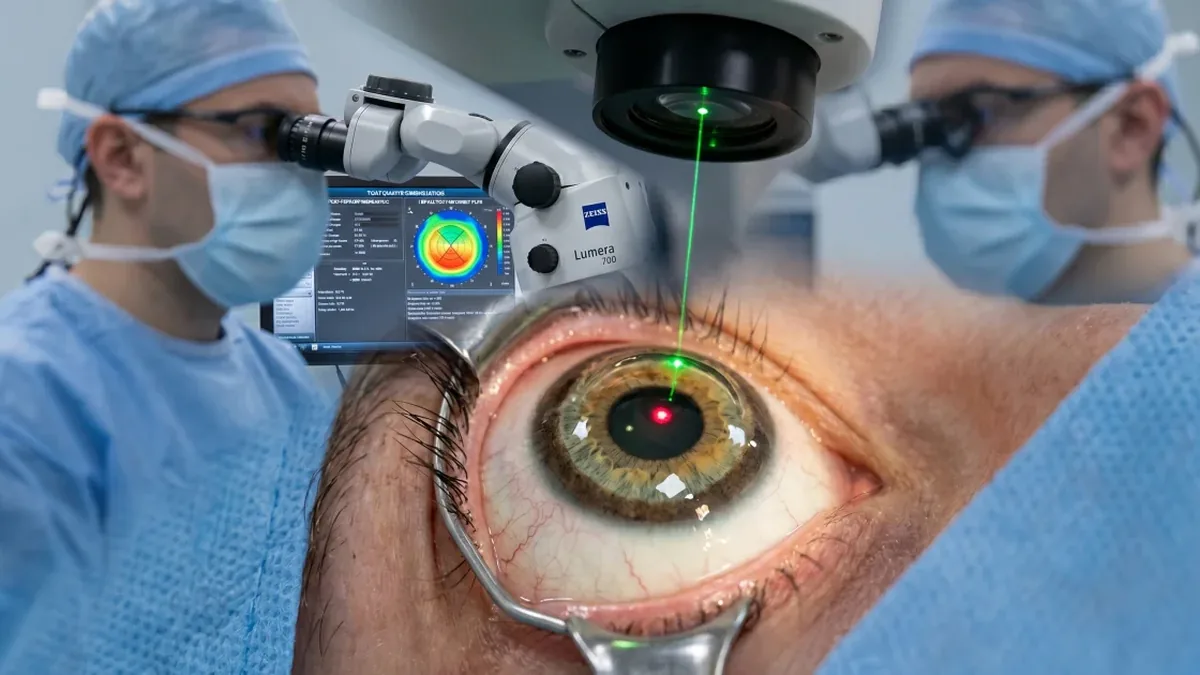

Can you have refractive surgery after keratopigmentation? Many patients who want to change their eye color also wear glasses or contact lenses and wonder whether they will still be able to correct their short-sightedness, long-sightedness or astigmatism later. Yoni Gozlan, M.D., ophthalmic surgeon in Paris 16 and member of the SFO and SAFIR, explains how the two procedures fit together, in which order they are done, how long to wait between them and which laser or implant techniques can be considered.
This page is about correcting your vision after a FLAAK keratopigmentation. If you have already had LASIK, PRK or SMILE and want to know whether you can change your eye color, read keratopigmentation after refractive surgery.
What is refractive surgery after keratopigmentation?
Refractive surgery after keratopigmentation covers the laser or implant procedures that correct a vision problem (myopia, hyperopia, astigmatism or presbyopia) in a patient whose eye color has already been changed by FLAAK keratopigmentation. These are two separate procedures acting on different parts of the cornea, which is why they can be combined under precise conditions.
In FLAAK keratopigmentation, a femtosecond laser creates a tunnel inside the corneal stroma, at a controlled depth, and medical pigments are placed in it. The central pupil area is left free of pigment. Refractive surgery, on the other hand, reshapes the curvature of the cornea or adds a lens inside the eye. Keratopigmentation does not change the optical power of the eye, so the vision correction can be planned afterwards on a stable basis.
In which order? Keratopigmentation first, then vision correction
If you want both a new eye color and a vision correction, the order followed by Dr. Gozlan is simple:
- Keratopigmentation comes first, then the correction of myopia (or of another vision problem).
- The two procedures are never done on the same day.
- At least 3 months must separate them. The exact timing is set at the examination, depending on how your cornea has healed.
Planning this sequence from the first contact avoids surprises: you know from the start that the color change and the vision correction are two separate steps.
Conditions for refractive surgery after keratopigmentation
Before any refractive surgery after keratopigmentation, several conditions are checked:
- Healed cornea: the stroma must have fully healed and the pigments must be stable in their tunnel. This is the reason for the minimum interval of 3 months.
- No inflammation: a careful slit-lamp examination must confirm that the eye is calm.
- Stable prescription: repeated, consistent refraction measurements must show that the correction needed is no longer changing.
- Sufficient corneal thickness: the remaining thickness must allow the chosen technique.
These points are part of the eye examination, as described in the article on the pre-operative consultation.
Refractive surgery after keratopigmentation: which techniques?
Several techniques can be considered, depending on the vision problem and on the state of the cornea. The choice is made with you at the examination.
PRK (photorefractive keratectomy)
PRK is a surface technique: the laser reshapes the most superficial layers of the cornea, without cutting a flap. It works above the depth of the pigment tunnel, which is why it is often considered in this situation. Visual recovery takes a little longer than with LASIK.
Femtosecond LASIK
LASIK involves creating a thin corneal flap before the excimer laser treatment. After keratopigmentation, the depth of the flap must be calibrated so that it does not reach the pigment layer. LASIK can only be considered if the corneal thickness allows it and if the pigments are deep enough.
Phakic implants (ICL)
For high corrections, or when the cornea is not suitable for laser treatment, a phakic implant (ICL type) is an alternative. It is placed inside the eye and does not touch the cornea, so it does not interfere with the pigments.
Specific precautions
A vision correction on a pigmented cornea requires a few additional precautions:
- Detailed corneal mapping: topography and tomography (Pentacam type) measure the thickness of the cornea and the depth of the pigments.
- Adapted laser settings: the settings of the excimer or femtosecond laser take the pigment layer into account.
- Clear central zone: as the pupil area is left free of pigment with FLAAK, the optical zone used for the correction stays clear.
Some measuring devices can be influenced by the pigments; this is taken into account when interpreting the results.
FAQ: refractive surgery after keratopigmentation
Can I have my short-sightedness corrected after FLAAK keratopigmentation?
Yes, refractive surgery after keratopigmentation is possible to correct myopia, provided the cornea has healed, the prescription is stable and the thickness is sufficient. Keratopigmentation is done first, and at least 3 months must pass before the vision correction.
Can both procedures be done on the same day?
No. Keratopigmentation and vision correction are never done on the same day. At least 3 months separate the two procedures, and the exact date is set after the examination.
Is LASIK risky after changing my eye color?
LASIK after keratopigmentation requires a careful assessment of corneal thickness and pigment depth, because the flap must not reach the pigment layer. That is why PRK or an ICL implant is sometimes preferred. The technique is chosen according to your eye anatomy.
Can my eye color change after refractive surgery?
The excimer laser reshapes the curvature of the cornea above the pigment tunnel; it is not designed to act on the pigment layer. This is one of the points checked at the examination before the vision correction.
Which tests are needed before the vision correction?
Corneal topography, corneal thickness measurement (pachymetry), optical coherence tomography (OCT) of the front of the eye and aberrometry map the cornea and locate the pigments. Eye pressure and the back of the eye are also checked.
I have already had LASIK. Can I still have keratopigmentation?
LASIK done years ago is not a problem for FLAAK keratopigmentation: as for every patient, the eye examination before the procedure checks your cornea. All the details are in the article keratopigmentation after refractive surgery.
Planning refractive surgery after keratopigmentation with Dr. Gozlan
If you are planning a color change and a vision correction, mention it from your first message. FLAAK keratopigmentation costs 5,500 € for both eyes and takes about 30 minutes for both eyes; the vision correction is a separate procedure, done at least 3 months later. Dr. Gozlan also runs a dedicated website on myopia surgery (in French).
The first step can be done from home: send photos of your eyes on WhatsApp for a first opinion, take the eligibility test or try the color simulator.
📍 Consultation at Centre Laser Victor Hugo – Paris 16
Yoni Gozlan, M.D. sees you at the Centre Laser Victor Hugo, 27 bis avenue Victor Hugo 75116 Paris to plan your keratopigmentation and, if needed, the later correction of your vision.
Book an AppointmentFurther reading
- Keratopigmentation after refractive surgery: if you have already had LASIK, PRK or SMILE.
- Contraindications to FLAAK keratopigmentation: situations in which the procedure cannot be done.
- FLAAK keratopigmentation surgery: how the procedure takes place, step by step.
- Pre-operative consultation: the examination before the procedure.